Everything you need to know about trekking to Meghalaya's living root bridges: the 3,500-step descent to Nongriat, Rainbow Falls, overnight stays, and which bridges are worth the effort.
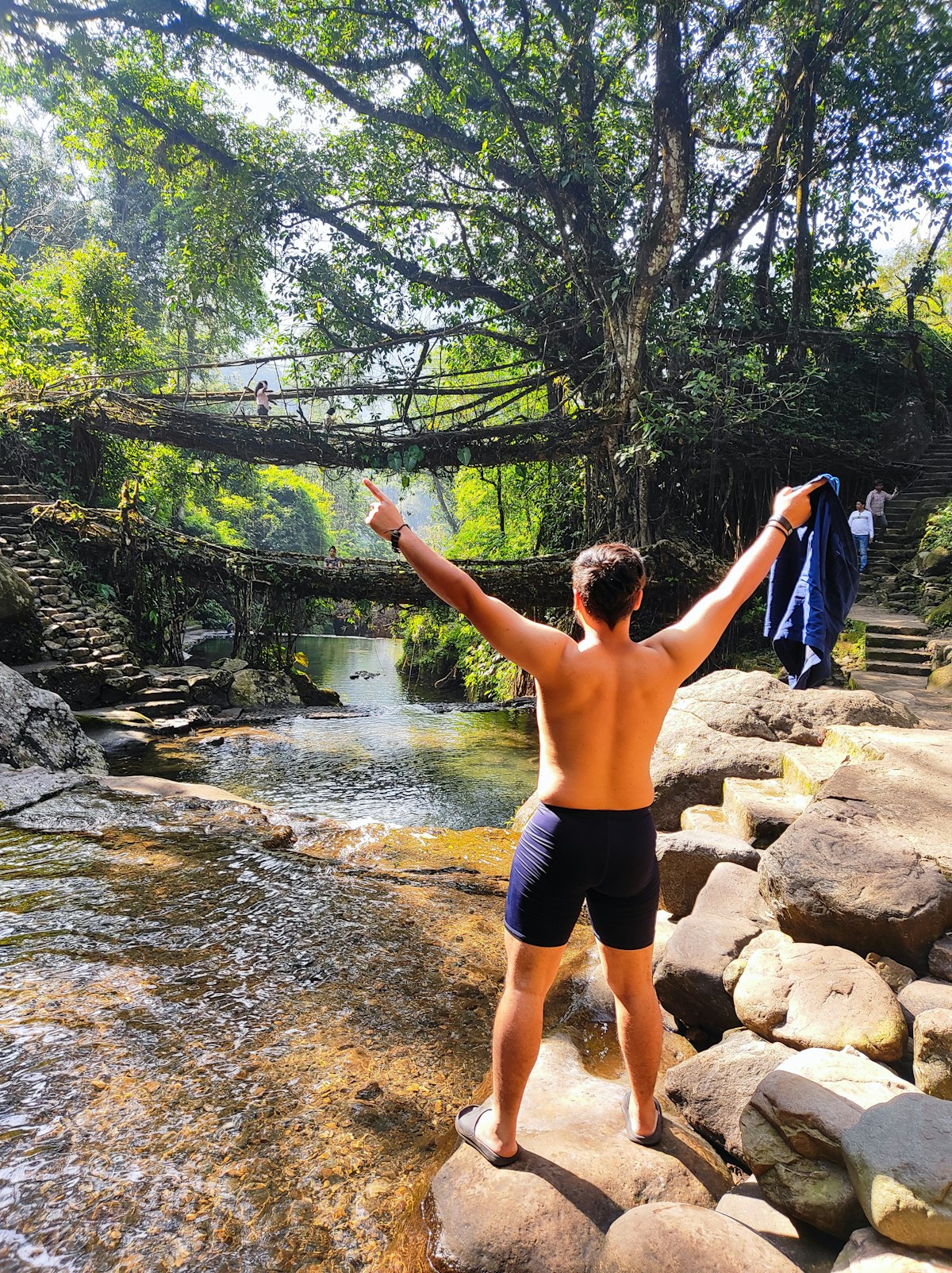
About 2,000 steps into the descent to Nongriat, somewhere in the middle of subtropical forest with sweat running down your back and your knees starting to complain, you round a bend and catch the first glimpse through the canopy. Two layers of gnarled, living tree roots spanning a river in a gorge so dense and green it looks prehistoric.
That's the Double Decker Living Root Bridge. You still have 1,500 steps to go. But now you know why you're doing them.
How These Bridges Exist
The Khasi people of Meghalaya build bridges from trees. Not lumber. Living trees.
They take the aerial roots of the Indian rubber fig (Ficus elastica), thread them through hollowed-out betel nut trunks laid across rivers, and guide the roots to the opposite bank. Over 15 to 30 years, the roots thicken, fuse, intertwine, and become a bridge. The betel nut trunk rots away. What remains is entirely alive, entirely functional, and unlike any man-made bridge, gets stronger with time. Some are estimated at over 500 years old.
Why roots instead of wood or steel? Meghalaya gets some of the heaviest rainfall on earth. Conventional bridges decay fast in the relentless moisture. A living bridge thrives in it. Each one belongs to a specific village and is maintained by the community. The knowledge passes down through generations, and new bridges are still being grown today.
UNESCO has been considering World Heritage status for them. Hard to argue against it.
The Double Decker Living Root Bridge at Nongriat, with two levels of living roots crossing the river
The Trek to Nongriat
Getting There
The trek begins at Tyrna village, about 12 km from Cherrapunji (Sohra). If you're staying in Cherrapunji, the drive is 25-30 minutes. Tell any driver "Tyrna" or "root bridge." There's a parking area, a few stalls selling water, and the stone stairway begins.
Going Down: 3,500 Steps
Roughly 3,500 hand-laid stone steps descending 730 meters. The path is maintained by local communities. Not a dirt trail. Proper stone steps, but uneven and slippery in places.
Time: 1.5 to 2.5 hours depending on pace and photo stops.
The first 30 minutes are the steepest. Steps cut into the hillside, dropping sharply through settlements and betel nut groves. Your knees will start talking early. After about 45 minutes there's a wire suspension bridge over a river (not a root bridge, but solid and scenic). Then the path undulates through small villages where you can buy water and fruit. The village of Nongthymmai has rest stops. Use them.
The final descent goes through thick forest. Air gets warmer, more humid. You hear the river before you see the bridge.
Suspension bridge crossing in the Meghalaya forest, part of the trek to Nongriat
At the Bridge
The lower deck spans about 25 meters at water level. The upper deck sits roughly 5 meters above it. Both are entirely living roots: thick, moss-covered, with ferns growing in the crevices and new shoots sprouting from the structure. You can walk across both levels. The lower deck has root railings and holds dozens of people at once without any flex.
Below the bridge there's a natural pool. Clean, cold water. On warm days, floating on your back looking up at a 500-year-old bridge while the forest buzzes around you is as good as travel gets.
Don't rush. You walked 3,500 steps for this. Sit on the rocks. Swim. Walk the bridge a few times. Watch the light shift through the canopy.
Staying Overnight
Do this. Day-trippers cluster around the bridge from 10 AM to 2 PM and leave. If you sleep in Nongriat, you get the bridge at dawn. Mist on the river. Complete silence. Just you and a structure that's been alive for centuries. The difference between seeing this place with 40 people and seeing it alone is the difference between visiting and experiencing.
Guesthouses in Nongriat run INR 300-500 per night. Basic rooms, shared bathrooms, simple food (rice, dal, vegetables, sometimes chicken). No hot water, no reliable power, no WiFi. Bring a sleeping bag liner and a headlamp.
Coming Back Up
This is the part nobody enjoys.
Those 3,500 steps that felt fine on the way down become a cardiovascular event on the way up. Thighs burn. Lungs work. Resolve wavers.
Time: 2 to 4 hours. The spread is real. Fitness matters, but so does pacing. Start early (6-7 AM if you stayed overnight) to avoid heat. Bring at least 2 liters of water. Stop every 15-20 minutes. Eat well before starting. Trekking poles help the knees significantly.
At the top you'll collapse at a Tyrna stall, drink something cold, and feel like you earned every sip. You did.
Rainbow Falls
If you stayed overnight, this is non-negotiable. Forty-five minutes beyond the Double Decker Bridge, along a forest trail following the river. The waterfall isn't the biggest in Meghalaya, but on sunny mornings (9-11 AM) the spray catches sunlight and creates a vivid, persistent rainbow in the mist. It's there every sunny morning. Not luck, just angles and water.
The trail passes another single-decker root bridge and a secluded swimming pool that's quieter than the one at the double decker. Tell your guesthouse host you're going and ask if a guide is worth it (INR 300-500). The path is findable without one, but a guide knows the forest.
Other Root Bridges
Riwai (near Mawlynnong). 10-minute walk from Riwai village. Easy. A single-decker bridge in a shaded forest setting. The alternative if the 3,500-step trek is off the table. Combine with Mawlynnong and Dawki.
Rangthylliang. Near Pynursla. Less visited, more intimate. Moderate trek, 1-2 hours. Ask locally for directions.
Mawsaw. One of the longest single-span root bridges. Near Mawsaw village in the Pynursla region. Moderate trek, 2-3 hours round trip.
Nongbareh. A double-decker in a more remote location. 6-7 hours round trip. Less infrastructure, far fewer people. The frontier for root bridge trekking.
Can You Do This Trek?
Yes, if: you can climb 5-6 flights of stairs without stopping, you exercise at all (even walking counts), your knees and ankles work reasonably well, and you're willing to go slow and take breaks.
Think carefully if: you have chronic knee problems, are significantly overweight, have a heart condition, or haven't exercised in months. The ascent could take 4+ hours and it's genuinely exhausting.
Consider Riwai instead if: you have mobility limitations, serious joint issues, are traveling with children under 8, or don't want 4-8 hours of stairs in a day.
Preparation: If you have a few weeks, walk stairs daily (10-20 flights, both up and down). Squats and lunges help. If you have no prep time, take it slow, buy a bamboo walking stick in Tyrna (INR 50-100), and don't feel bad about stopping constantly. Stay overnight so you split the effort across two days.
Gear
Bring: Trekking shoes with good grip (stone steps get slippery, flip-flops are asking for injury). 2-3 liters of water. Light rain jacket. Sunscreen. A 20-30L backpack. Snacks. Cash, INR 2,000-3,000 (no UPI, no ATMs down there). Headlamp if staying overnight. Basic first aid, especially ibuprofen for the morning after.
Optional but useful: Trekking poles, swimwear, quick-dry towel, dry bag for electronics, change of clothes, sleeping bag liner, insect repellent.
Leave behind: Heavy camera gear (unless you're willing to carry it up 3,500 steps), laptop, anything you'll resent carrying.
When to Go
Period
Conditions
Notes
October - November
Clear, comfortable, waterfalls still flowing
Best overall
December - February
Dry, cool, less water for swimming
Excellent for trekking
March - April
Warming, occasional rain, lush
Very good
May
Hot, humid, pre-monsoon storms
Doable but sweaty
June - September
Monsoon, slippery steps, leeches, high river
Avoid
Costs
Item
Cost
Shared taxi, Sohra to Tyrna
INR 100-200
Private cab, Sohra to Tyrna
INR 500-800
Local guide
INR 500-800 per group
Guesthouse in Nongriat
INR 300-500
Meals in Nongriat
INR 300-500
Trail snacks and water
INR 200-300
Entry
INR 50-100
Day trip total
INR 500-1,000
Overnight with guide
INR 1,500-2,500
One of the cheapest remarkable experiences available in India.
Things Worth Knowing
Start early. The gorge loses direct sun by mid-afternoon. Morning light through the canopy is when the bridge photographs best.
Hire a local guide even if the path is clear. They turn a trek into a story. Names of plants, histories of villages, legends behind waterfalls. And the income goes to families who maintain the paths you're walking on.
Porters are available at Tyrna if you have heavy bags or physical limitations. Common and respected. About INR 500-800.
Phone signal: BSNL works sporadically in the valley. Airtel and Jio mostly don't. Tell someone your plans before descending.
If you have one day for adventure in Meghalaya, this is the one to pick.